Wednesday, 8 February 2023
EXCERPT SUNDAY - WIP 'FOR KING AND COUNTRY'
Jack de Laverton is in serious trouble and, not for the first time, a woman is the cause! (I haven't given you her name on purpose!)
Monday, 3 October 2022
ππANNUAL GENERAL MEETING OF THE RICHARD III SOCIETY LEICESTER. ππ
Wednesday, 20 July 2022
πππRICHARD III AND
SIR THOMAS MARKENFIELDπππ
As my new WIP comes up to Bosworth Field, I may have found a new character we haven't met before: Sir Thomas Markenfield. Quite how he will fit with Thomas Conyers and Sir John de Laverton we will have to see, but it's certainly going to be interesting - you know what Jack is like!!!
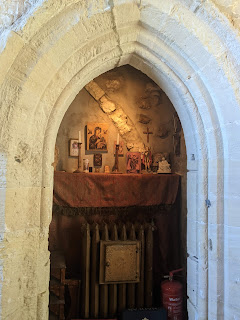
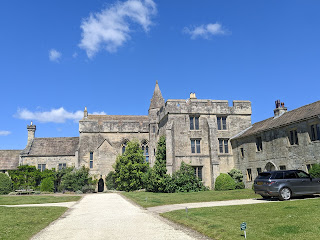
Markenfield Hall is in North Yorkshire, near Ripon. The present house dates back to 1310 when "Licence to John Merkyngfeld, King's Clerk, to crenellate his dwelling house at Merkyngfeld Co. York 2 Feb 1310" was granted. The nearby lordships of Middleham and Sheriff Hutton were inherited by the 'junior' branch of the Neville family in 1453 and had been administerd by Richard Neville, 16th Earl of Warwick until his death at Barnet in 1471. Edward IV knew how vital these lordships had been, both to Warwick's northern powerhouse, and to maintaining the border with Scotland and therefore granted these estates to his then 18 year old brother, Richard duke of Gloucester.
Since the fourteenth century the manor of Markenfield had leaned towards the Nevilles, even though the Percy manors of Spofforth and Topcliffe are closer to Markenfield than Middleham. This was because most of the family's estates were in Richmondshire and the feudal infrastructure of the independant lordship of Richmond meant that military service remainded at the heart of the relationship with the lords of Richmond, which had been the Nevilles since Ralph Neville had been granted the lordship by Henry IV. The lordships of Middleham and Richmond were integrated into one administration, and it was this complex of Warwick's that Edward IV settled on Gloucester and with it the allegiance of the Markenfields. In 1431-2 John Markenfield had served under Richard Neville, earl of Salisbury (father of the earl of Warwick) in France. His tomb effigy in Ripon Cathedral wears a Neville livery collar as depicted in the Neville Hours showing Ralph Neville and his family at prayer.
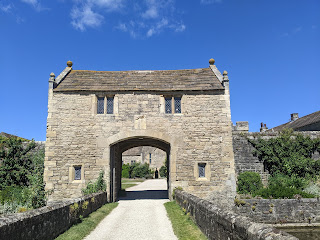
It is not known when Thomas Markenfield married Sir John Conyers' (the steward of Middleham) daughter Elinor, but when he did so, he was joining the family business. Markenfield was formally retained by Gloucester on 11th December 1471. He was paid a fee of £10 per annum from Middleham, the fourth highest fee of the 27 knights and esquires retained by Gloucester up to September 1473. Pollard has suggested that a personal bond formed between Gloucester and Markenfield as, unlike most of the retainers, Markenfield was only some 5 years older than Gloucester. Markenfield's second son born c1476 was named Ninian. Ninian was a saint known to be favoured by Gloucester, and it is possible that Gloucester was a Godfather to the child, who may have been Christened on the saint's feast day of 16th September.
There
is no record of Markenfield's service to Gloucester before 1483, but as
the indentures from Middleham were most importantly militrary in
aspect, as with Warwick, it is likely that Markenfield went with
Gloucester to France in 1475 and perhaps shared with him the
disappointment at Edward IV's settlement. He probably also campaigned in
Scotland with Gloucester in 1481 and 1482.
He was later made a knight of the body to Richard and pricked as sheriff of Yorkshire and by the end of 1484, Sir Thomas Markenfield was at the very heart of Richard III's regime.
It is unclear whether Markenfield fought at the Battle of Bosworth. The 'Ballad of Bosworth Field' identifies him as one who came to the king on the eve of the battle, which would then mean as a knight of the body he would have fought alongside Richard and participated in the last charge. However, as sheriff of Yorkshire his duty was to raise troops for the king in the company of the earl of Northumberland who, for whatever reason, did not engage. Since Markenfield was not among those charged with treason by Henry VII (dating the start of his reign to the day before the battle!) it is unlikely that he fought, though he was one covered by a genreal pardon to the men of the north. He did take out a pardon, though specifically for his period of service as sheriff, as was usual practice. He was not one of the Ricardians placed under a hefty bond for future good behavior by Henry VII and attended upon him in York in May 1489. He came to terms with the new regime, much as his father-in-law, Sir John Conyers had done throughout the previous turbulence, and, as Henry Tudor was the true earl of Richmond it was perhaps the older fealty that held sway, especially as Markenfield had only been retained by Richard for the duration of Richard's lifetime.
Sources: North-Eastern England During the Wars of the Roses: Lay Society, War and Politics, 1450-1500. A J Pollard (1990)
Sir Thomas Markenfield and Richard III A J Pollard The Friends of Markenfield Hall 8
The Markenfields of Markenfield Hall Janet C Senior
Monday, 27 June 2022
A WARWICK! A WARWICK!
It has been a while since I've visited the favourite home of our hero, Richard Neville 16th Earl of Warwick. Warwick Castle came to him, aged 20, as earl of Warwick in right of his wife as part of her Beauchamp inheritance and it seems that Richard identified strongly with the Beauchamp legacy. Keeping possession of the inheritance was however not easy. As Anne de Beauchamp's late brother, duke Henry of Warwick had attained his majority and received livery of his estates, the whole should have passed to his only surviving sister, on the grounds of the exclusion of the half-blood (the half sisters by their father's first wife).
There were three elements: the Beauchamp estates which the new Countess inherited from her brother; the lordship of Abergavenny in which she was also sole heir of her brother; and the Despenser estates, in which she was the joint heir of her mother. There were other elements that Richard Beauchamp had put in Trust. The half sisters did not hesitate to claim a quarter share each of the Beauchamp estates not in Trust, and John Talbot, earl of Shrewsbury, as husband of the eldest daughter Margaret, even had hopes of the title himself! The inquisitions post mortem when eventually held unanimously concluded in every county that Warwick's countess was the sole heir. The sisters continued to contest the decisions and the new earl spent much of his time fighting (at times literally) to keep hold of and even gain estates. The sisters had no claim to the Abergavenny or Despenser lands buyt the descent of these was complex due to the intermarriage of cousins.Warwick annexed all the Despenser lands, even though only half ewre his countess's by right. The earl's possession was endorsed by key Beauchamp councillors, administrators and retainers including Nicholas Rody, Thomas Hugford, and William Berkeswell, dean of St Mary's Warwick who had served Beauchamp since the1420's or earlier. Others also moved to Warwick's service and were key supporters of his countess as sole heir to the Despenser estates.
Warwick spent much of his time residing at Warwick and visiting neighbouring lordships. He enthusiastically adopted the traditions of the earldom, in relation to the bear and ragged staff and the legend of Guy of Warwick as founder of several monasteries, espcially Tewkesbury, as patron of Guy's Cliffe chantry and the collegiate college of St Mary's at Warwick where the famous Beauchamp chapel under the offices of these men, was being built - but that's another post!
Ref: Warwick the Kingmaker Prof A J Pollard Continuum 2007
Monday, 1 June 2015
Character Blog Hop
I have been tagged in the Meet My Character Blog Hop by fellow indieBRAG honoree author and historical re-enactor Paula Lofting and if you click the link you will be able to read her excellent post about her amazing character, Wulfhere.
These are the questions Paula asked me:
What is the name of your character?Jack de Laverton
Although Jack is fictional his experiences are typical of those caught up in the dark times of what we know as the Wars of the Roses, where blood wasn't always thicker than water!
Sunday, 23 June 2013
When you watch The White Queen tonight...
And yesterday The Tudor Group were there presenting a Tudor wedding, complete with wedding breakfast, Tudor games and dancing. I was so impressed by the Tudor Group; their kit is amazing, their research thorough and their knowledge extensive and it was great to chat about the similarities and differences between 'our' periods.
We talked about the etiquette and ceremony of a Tudor (or medieval) feast - the luxury of choice, the reverence with which the servants treated their betters, even when encountered in the garden (reminded me of Kim Phillips' excellent paper on the Earl of Warwick at Middleham) and the pride with which the household liveried retainers wore their badges.
And of course The White Queen was mentioned - why? Because you won't see any of this in the BBC dramatisation (we talked about actors' reluctance in wearing hats or in Max Irons' case not adopt the hairstyle either!). Such a shame that the actors and producers missed a wonderful opportunity to educate as well as entertain the public as the Tudor Group did so brilliantly.
Reference:
Kim M. Philips Journal of Medieval History 31 (2005) 143 'The Invisible Man: Body and Ritual in a fifteenth-century noble household.
Sunday, 9 June 2013
'Sons of the Wolf' Blog Tour
Although ‘Sons of the Wolf’ is a work of fiction it is based on historical fact. How did you go about researching it? After I had decided on my subject, I started researching articles about the 11thc on the net and stumbled across www.regia.org website and found that apart from some really interesting, useful articles, they also did living history and battle re-enactment and thought that it would be a wonderful way of learning firsthand what it was like to live a thousand years ago in England. I contacted them and found that they had a group in Sussex where I live. Having joined them, I now realise that the enjoyment of re-enacting far outweighs the enjoyment of the research aspect. It’s a great life and I wish I had joined earlier. For the events and politics of the time I read widely and look for primary sources to ensure as much accuracy as possible.
Do you feel any responsibilities as a writer of historical fiction? Definitely. Everyone has something to say about this don’t they,J. I know that there are lots of authors and readers who are not too fussed about historical accuracy and that’s fine, but for me, it wouldn’t feel right if I didn’t at least try to stick to the facts as far as I possibly can interpret them. I wouldn’t feel comfortable with changing or making up facts to suit my story and I wouldn’t want to attribute good or bad deeds to a historical figure if it were not true.
What can a modern readership learn from the hardships of Wulfhere and his family and the Anglo Saxons in general? Probably the first lesson would be not to take for granted our nice cosy lives and to appreciate and respect our ancestors for paving the way for us. If not for their hardships, we would not be the people we are today. It was a hard cruel world, for both the peasants and the nobility. Families like the Wulfheresons from my story, enjoyed the comforts of plenty of food, servants to help them, decent clothing and a great hearth to warm their home, but they still endured hardships such as having their crops ruined by weather; damp, cold drafty rooms; illness and untimely deaths caused by something as minor as a witlow on their fingernail; death in child birth; invading marauders; it often made no difference what your status was, it was a hard life for everyone, though much harder for some others. No soft toilet roll to use in a nice flushing loo; no antibiotics to cure your infections; shivering in long cold winter nights. Wulfhere might have been a thegn (a low-ranking noble) but he still would have had to chop wood for fuel, work hard mending bridges and fencing around the King’s demesne as well as maintaining his own buildings. His wife Ealdgytha would have spent her day spinning wool, weaving cloth or sewing clothing for her family. She would have had to see that everyone was fed and watered and oversee the work around the home and make sure the farm ran smoothly. I think we also take for granted today that we have the potential to live long healthy lives, in medieval times, if you survived past 5 years old, you might be lucky to live till you were 25, perhaps less if you were female, with the chance of dying in child birth. I could probably go on forever!
What are you currently working on? I’m currently working on the sequel to Sons of the Wolf, The Wolf Banner. It follows Wulfhere’s fortunes further and leads us closer to the Battle of Hastings. It also continues with the fortunes of the historical characters of that time too.
And finally, where can readers learn more about your work?
My website is: http://www.paulalofting.com/
And 'Sons of the Wolf' is also available from Amazon in both the UK and US.
Thanks Paula, it's been great to chat with you!
IndieBRAG: Your source for quality self-publishing.