Thursday, 11 April 2013
'The Colour of Treason' wins an award
Monday, 1 April 2013
'The Violent Death of the King in the Car Park'. Talk by Bob Woosnam -Savage Royal Armouries, Leeds, Wednesday 27th March 2013.
According to Robert Woosnam-Savage, Curator of European Edged Weapons at the Royal Armouries, Leeds satisticians
have calculated that the chances of finding the skeleton of Richard III were
0.834%. I'm not sure I agree with that, not if the archaeologists had done their homework, but it does show just how close they came to not finding the bones of the last English king to die in battle, King Richard III.
Robert talked for over two hours about the prelude to Bosworth, the setting of the battle and the drawing of battle lines and their subsequent redrawing recently when the largest concentration of shot from any medieval battlefield in Europe were found by Dr Glenn Foard of the Battlefield's Trust and his team. So far 30 - mainly 25-65mm; but the largest 93mm weighing 7.2 Kg - which put the site beyond doubt. And the subsequent treatment of Richard's body with it's eventual burial at Grayfriars in Leicester and these are a summary of some of the notes I took.
At the site: Skeleton found on the first day less than 1 car’s width from the ‘R’ painted on the car park! The main focus of his talk was on the wounds and how they might have been inflicted and what these could tell us about Richard's last moments.
Analysis:
The skeleton was from a Caucasian male ~35 years of age.
There were 12 wounds on the body - 9 Cranial and 3 post-cranial. This is higher than the average number of wounds from those recovered at Towton which was 4.2, though the highest at Towton was 14.
This is likely to be an underestimate as there would probably also been flesh wounds - wounds that left no trace on the skeleton. Small teeth - especially back ones and had lost 1st left upper molar.
Suggestion that the hands were still tied at the time of burial by their position. There was no evidence of coffin or shroud and the hole was not large enough for the body therefore the skeleton is rather crumpled. The feet were missing.
Richard’s standard bearer at Bosworth Sir Percival Thirwell died after having his feet sliced away during the battle, possibly with a two-handed sword but more likely with a bill or Halberd - however Richard’s feet were likely lost to previous building on the site (Victorian toilet).
On examination the spine showed significant scoliosis, this developed at puberty and increased in severity with age.
There is still much work to be done on how this affected Richard but likely that his head would be off centre - over to the right.
If his spine had been normal he would have stood about 5’ 8’’ in height but with his spinal deformity he could have been up to 1’ shorter - however if this extreme was the case it is likely that this would have been mentioned by contemporaries.
Wounds were classified using experience of forensics team and using as a guide the cranial trauma identification chart developed by Caroline Needham in 1999.
Evidence of ante-mortem wounds? Was there any evidence for the injuries that Richard was known to have suffered at Barnet? Nothing so must have been a flesh wound only.
Contemporaries state that Richard died leading a charge against Henry Tudor.
It is known from contemporary accounts that the Earl of Oxford told his men to ‘stay within 10’ of your standard’. (Vatican record has 4’ but this has then been crossed out).
Richard kills Tudor’s standard bearer Brandon - so must be very close to Tudor - may have even crossed swords with him if he was that close to his standard.
Why did he charge?
Desperate move as the battle was turning against him?
Deliberate brave move - almost made it!
Charge stalled by - men + marsh?
Accounts say Richard fights on foot and kills several men -
Horse either stuck in the marsh or slain?
? chose to dismount as English tended to fight on foot.
Richard is well protected but his armour fails under a ferocious attack.
Evidence:
Wounds

4.
Occipital wounds (posterior base of the
skull)
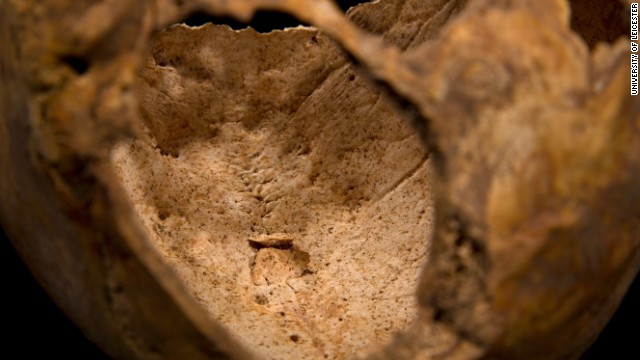
(a) There is a large wound to the right occipital which although possibly not fatal would have exposed the brain and there would have been a lot of blood. Seen in top of picture below.

(b) Penetrating wound to the left occipital which goes all the way through (~100mm in length) and has marked the inside of the top of the skull. This would have been fatal.

Blows likely
dealt with Richard on the ground - either kneeling or in a probe position.
Interestingly these may fit with some contemporary writings about Richard’s
death:
Jean Molinet was historiographer to the Burgundian court and sympathetic to the Yorkist cause. His account of Bosworth in Chroniques was written c.1490. He interviewed veterans after the battle. In it he states: ‘One of the Welshmen then came after him, and struck him dead with a halberd’.
Other contemporary evidence comes from a poem by a Welsh poet called Guto'r Glyn. He composed a poem in praise of Rhys ap Tomos, one of the main supporters of Henry Tudor in his campaign. Rhys led an army of Welshmen to support Henry on the battlefield at Bosworth, and was then knighted for his services to the king. Not long after, Guto'r Glyn sang a poem in praise of his exploits, and he talks about the killing of Richard. He actually says Richard’s head was 'shaved'. This had previously been understood in a figurative sense; perhaps that his head had been chopped off. But it seems from looking at the wounds to the skull, that this was meant quite literally: that someone had chopped across the top of his head, cutting off a chunk of his hair and a bit of skull with it.
5. Other wounds
These could only have been delivered to an un-armoured man therefore are post-mortem and are humiliation or insult injuries.
(a) Nick in the right 10th rib just above the kidney ~5mm in length - possibly from a sword or dagger.
(b) Pelvis trauma.
This is a fine wound ~30mm in length and is a cut delivered by a knife. It is
seen just right of the midline and goes through the right buttock. Possible
that this was delivered with Richard slung over the back of a horse.
Unlike the victims of Towton there was no facial mutilation nor any attempt to remove ears as trophies such as seen on Towton 32.
Robert talked for over two hours about the prelude to Bosworth, the setting of the battle and the drawing of battle lines and their subsequent redrawing recently when the largest concentration of shot from any medieval battlefield in Europe were found by Dr Glenn Foard of the Battlefield's Trust and his team. So far 30 - mainly 25-65mm; but the largest 93mm weighing 7.2 Kg - which put the site beyond doubt. And the subsequent treatment of Richard's body with it's eventual burial at Grayfriars in Leicester and these are a summary of some of the notes I took.
At the site: Skeleton found on the first day less than 1 car’s width from the ‘R’ painted on the car park! The main focus of his talk was on the wounds and how they might have been inflicted and what these could tell us about Richard's last moments.
Analysis:
The skeleton was from a Caucasian male ~35 years of age.
There were 12 wounds on the body - 9 Cranial and 3 post-cranial. This is higher than the average number of wounds from those recovered at Towton which was 4.2, though the highest at Towton was 14.
This is likely to be an underestimate as there would probably also been flesh wounds - wounds that left no trace on the skeleton. Small teeth - especially back ones and had lost 1st left upper molar.
Suggestion that the hands were still tied at the time of burial by their position. There was no evidence of coffin or shroud and the hole was not large enough for the body therefore the skeleton is rather crumpled. The feet were missing.
Richard’s standard bearer at Bosworth Sir Percival Thirwell died after having his feet sliced away during the battle, possibly with a two-handed sword but more likely with a bill or Halberd - however Richard’s feet were likely lost to previous building on the site (Victorian toilet).
On examination the spine showed significant scoliosis, this developed at puberty and increased in severity with age.
There is still much work to be done on how this affected Richard but likely that his head would be off centre - over to the right.
If his spine had been normal he would have stood about 5’ 8’’ in height but with his spinal deformity he could have been up to 1’ shorter - however if this extreme was the case it is likely that this would have been mentioned by contemporaries.
Wounds were classified using experience of forensics team and using as a guide the cranial trauma identification chart developed by Caroline Needham in 1999.
Evidence of ante-mortem wounds? Was there any evidence for the injuries that Richard was known to have suffered at Barnet? Nothing so must have been a flesh wound only.
Contemporaries state that Richard died leading a charge against Henry Tudor.
It is known from contemporary accounts that the Earl of Oxford told his men to ‘stay within 10’ of your standard’. (Vatican record has 4’ but this has then been crossed out).
Richard kills Tudor’s standard bearer Brandon - so must be very close to Tudor - may have even crossed swords with him if he was that close to his standard.
Why did he charge?
Desperate move as the battle was turning against him?
Deliberate brave move - almost made it!
Charge stalled by - men + marsh?
Accounts say Richard fights on foot and kills several men -
Horse either stuck in the marsh or slain?
? chose to dismount as English tended to fight on foot.
Richard is well protected but his armour fails under a ferocious attack.
Evidence:
Wounds
1.
Right sided cuts to the jaw:
a) Lower jaw
b) Near hinge point.
These were
delivered by a knife possibly cutting away the strap to forcibly remove his
helmet. Bone chipped away ~ 5mm in length.
2.
Penetrating wound to right maxilla
Small
rectangular hole. Relatively fragile bone. ? delivered post mortem or from
behind. This could not have been delivered with helmet in situ. This was not an
attempt to kill but would have been painful. Has a square profile - likely a
dagger strike.
3.
Wounds to the top of the head
(a) Left posterior cranium. Outer surface of
the skull removed (death star appearance). This was from a bladed weapon -
striations/curve or ‘scoop’ up from the base.
(b) Second scoop can be seen and the
striations can be compared to see if this is from the same weapon. Neither of
these blows were fatal nor were they attempts to scalp, though they would have
lifted flaps of skin resulting in a lot of bleeding. Similar to Towton 11.
(c) Non-fatal penetrating would to the top of
the skull; has a rectangular profile so likely a dagger (Rondel). No fractures
near this wound so not percussive force. A ‘key-hole’ wound ~2-3mm wide. This
did not go all the way through but dislodged 2 small bits of bone so was
delivered with some force. Richard would be on the ground so there is likely a
2-handed delivery.
(a) There is a large wound to the right occipital which although possibly not fatal would have exposed the brain and there would have been a lot of blood. Seen in top of picture below.
(b) Penetrating wound to the left occipital which goes all the way through (~100mm in length) and has marked the inside of the top of the skull. This would have been fatal.
Jean Molinet was historiographer to the Burgundian court and sympathetic to the Yorkist cause. His account of Bosworth in Chroniques was written c.1490. He interviewed veterans after the battle. In it he states: ‘One of the Welshmen then came after him, and struck him dead with a halberd’.
Other contemporary evidence comes from a poem by a Welsh poet called Guto'r Glyn. He composed a poem in praise of Rhys ap Tomos, one of the main supporters of Henry Tudor in his campaign. Rhys led an army of Welshmen to support Henry on the battlefield at Bosworth, and was then knighted for his services to the king. Not long after, Guto'r Glyn sang a poem in praise of his exploits, and he talks about the killing of Richard. He actually says Richard’s head was 'shaved'. This had previously been understood in a figurative sense; perhaps that his head had been chopped off. But it seems from looking at the wounds to the skull, that this was meant quite literally: that someone had chopped across the top of his head, cutting off a chunk of his hair and a bit of skull with it.
5. Other wounds
These could only have been delivered to an un-armoured man therefore are post-mortem and are humiliation or insult injuries.
(a) Nick in the right 10th rib just above the kidney ~5mm in length - possibly from a sword or dagger.
Unlike the victims of Towton there was no facial mutilation nor any attempt to remove ears as trophies such as seen on Towton 32.
This is because
it is likely that Richard fell forward i.e. was killed from behind and also
that there were orders to save his face for later recognition, possibly a direct
order from Henry Tudor who was close by.
No defensive
wounds have been found on Richard’s arms/forearms. These are the most common
wounds and at Towton often seen on the forearms. (Not feinting blows as has
been suggested - these are defensive - fending off attack and are instinctive).Therefore
likely that Richard’s armour stayed intact until his death.
Robert emphasized that there is still much work to be done and the final conclusions will not be delivered until late this year.
All photos Leicester University.
Monday, 25 March 2013
Keeping Up Appearances
There are many books, blogs and websites that offer writers advice when it comes to writing character descriptions: 'show don't tell'; 'less is more'; 'make the description tell us more about the character than just their physical appearance' etc. etc. Of course, by definition if you are writing fiction then the character exists clearly in your head and it is your job to communicate that to the reader, so that if they were asked to describe the character at the end of the novel they would come up with your character just as you imagined them. Writers of historical fiction often have a different problem they have to figure out for themselves in that the person they are writing about actually existed but there are either no contemporary likenesses of them or worse still there are sketchy ones available or vague descriptions (both on appearance and character) by contemporary writers which we may wish to believe or disbelieve depending on their relationship to the said character! The former does allow the writer more of a free rein to develop the character as their own, whereas the latter offers up a number of difficult choices.
One of my main protagonists in both 'The Colour of Treason' and 'A Rose of England' is Richard Neville, Earl of Warwick (you may know him as The Kingmaker) and unfortunately for me there are a few contemporary likenesses to pick and choose from:

There is a general family likeness in the mourners which is also apparent in the earlier 'Neville family at prayer' depicting Warwick's father and his siblings from the Neville Book of Hours c1430:
In addition the Neville family were generally regarded by contemporaries as being both handsome and tall and as a novelist that was one piece of information I certainly couldn't ignore!
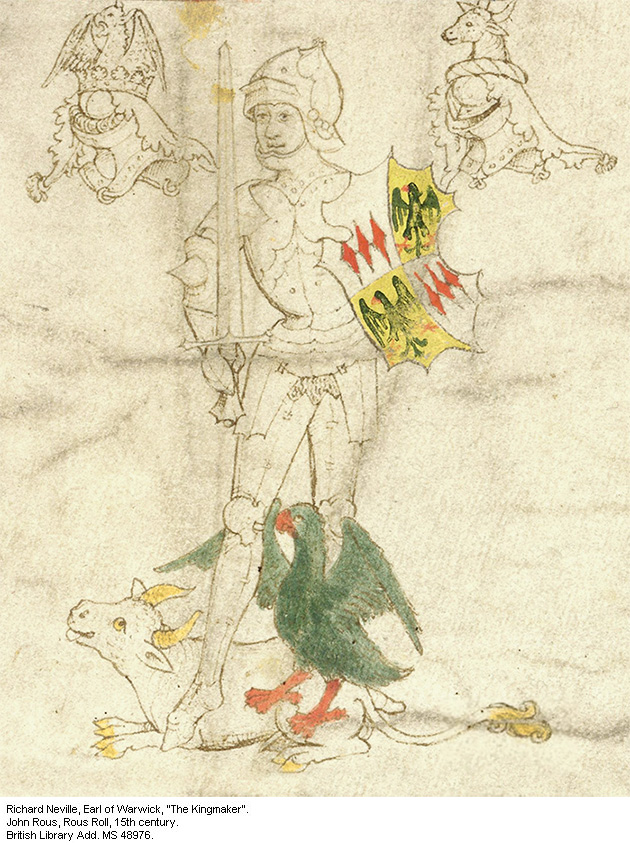
One of my main protagonists in both 'The Colour of Treason' and 'A Rose of England' is Richard Neville, Earl of Warwick (you may know him as The Kingmaker) and unfortunately for me there are a few contemporary likenesses to pick and choose from:
1. Probably the closest to life as he was involved in commissioning it in the 1450s: his depiction as a weeper on Richard Beauchamp's tomb in St Mary's Warwick. (Beauchamp was Warwick's father-in-law). This shows Warwick, perhaps symbolically, as an older man however, as he was only 42 when he died at the Battle of Barnet in 1471.
There is a general family likeness in the mourners which is also apparent in the earlier 'Neville family at prayer' depicting Warwick's father and his siblings from the Neville Book of Hours c1430:
2. So-called Rous Roll compiled 1483-85 during the reign of Richard III and probably by Warwick's widow, the Countess of Warwick - again highly stylised and probably no attempt at a likeness.
3. The last page in the so-called Beauchamp Pageant almost certainly commissioned by the Countess of Warwick - some attempt at a likeness here as all the figures have different faces. (He is top left as we look at it, pointing towards his countess).
This is painted on the wall at Warwick Castle and Richard Neville has dark brown wavy shoulder length hair and dark eyes:
And I have gone along with that colouring.
4.His death at the Battle of Barnet in the Besancon version of the Short Arrivall - painted some 10 years after the battle. He is fully armoured but appears quite tall. (Warwick is riding to the right on the white horse with a shield on his back).
5.By the manner of dress and hairstyle this image from the Founder's and Benefactor's book of Tewkesbury Abbey is likely to be mid-sixteenth century and therefore not a true likeness:
In addition the Neville family were generally regarded by contemporaries as being both handsome and tall and as a novelist that was one piece of information I certainly couldn't ignore!
Saturday, 23 March 2013
A Rose of England - Palm Sunday 2013
As you all may know by now, the annual pilgrimage that is the Palm Sunday Battle of Towton Memorial event has had to be cancelled this year due to the poor weather. This was going to be a book launch day for a number of authors, myself included, so instead I'm posting the trailer for the new novel. Hope you like it!
Sunday, 3 February 2013
Tomorrow's the BIG day
I can't think of a precedent for what's going to happen tomorrow. Tomorrow we shall learn whether the male remains found at the former Greyfriar's Priory site in Leicester are those of the late King Richard III. For all those interested in the Wars of the Roses and for those with an interest in King Richard in particular it is an understatement to say it's going to be an interesting day! Regardless of whether the remains are those of this controversial king, it's a great day for archaeology, highlighting the use of modern methods and techniques not only for identification purposes, but also for the reconstruction of the facial features of the deceased. Although the techniques are now much improved I can remember being excited about a BBC television series which began in 1998 presented by Julian Richards, which sought to 'Meet the Ancestors' using facial reconstruction and I notice the Leicester team are employing the services of Dr Caroline Wilkinson a CRFP registered facial anthropologist/forensic artist who worked on the series in their reconstruction of 'Richard'. I was always fascinated by her work of 'bringing the dead to life' and as a writer of Historical Fiction set in the Wars of the Roses this time I am doubly so!
My current WIP is set in 1470, and Richard features only slightly, in a supporting role to his brother Edward IV as he is exiled and then tries to reclaim his crown from the Earl of Warwick acting for Henry VI, but Richard will feature much more strongly in the follow-up to that and to have one of Caroline's reconstructions would be awesome! Not only will we know what his face was like we should also learn more about any illnesses he may have had as well as his build and stature and more insight into how he died at Bosworth and whether any injuries were inflicted post mortem as was reported in the chronicles of the time. All wonderful stuff for an author about to start a novel covering those events and featuring the 'much-maligned king'!
Friday, 25 January 2013
Excited
I am hard at work editing the WIP - the sequel to The Colour of Treason - and as I am quite a while behind schedule due to things beyond my control, let's just say I'm finding it harder than it should be to finish! But I am now a little more enthusiastic as I have had two 5* reviews - one on Amazon and one on Goodreads! Thank you guys - you have really fired me up to finish the next book! Hopefully done and dusted in time for the annual Palm Sunday memorial event at Towton!
Monday, 7 January 2013
The Next Big Thing Blog Hop
The Next Big Thing Blog Hop is a chance for authors around the world to tell you what they’re working on. The author answers 10 questions about their next book, and tags the person who first tagged them. My thanks to Karen Clark, a fellow Neville adherent, for tagging me.
What is the working title of your book?
A Rose of England; apt because the central character is a woman who we find in France and Bruges in this novel, so literally a rose of England, but a rose also because it is set in the Wars of the Roses.
Where did the idea come from for the book?
This book is the sequel to The Colour of Treason and they were always conceived together; the original inspiration was the Middleham Jewel, a fifteenth century reliquary in the Yorkshire Museum in York. As I began to read more about it and the people who could have been connected to it, the story began to form in my mind.
What genre does your book fall under?
Historical fiction, but both from male and female points of view.
Which actors would you choose to play the part of your characters in a movie rendition?
I haven’t a person in mind for Elizabeth Hardacre, but I always imagined her as Alexa Wilding, a model for the pre-Raphaelite Dante Gabriel Rossetti such as she is in 'Sibylla Palmifera'. James Purefoy would be Richard Neville, the Earl of Warwick; a young Mark Ryan or possibly Aidan Turner would be Jack de Laverton. A young Heath Ledger would be Thomas Conyers and Tom Georgeson would play Higgins.
What is the one sentence synopsis of your book?
After love and betrayal can there be forgiveness?
Will your book be self-published or represented by an agency?
For personal reasons I had to self-publish The Colour of Treason and I did so as both a paperback and ebook. Even though it was a lot of work, I will probably do the same for 'A Rose of England'.
How long did it take you to write the first draft of the manuscript?
Difficult to say as the two books are so entwined, but from the initial writing to now has taken seven and a half years. I also research as I write; I lay out a basic timeline with major events on it first and use that as a structural template, but I am flexible and if I come across something interesting then it can take the characters in a new direction.
What other books would you compare the story to in your genre?
In scale it is perhaps similar to Sharon K Penman’s 'Sunne in Splendour', but not in style. It is more like Elizabeth Chadwick meets Bernard Cornwell as I write from both male and female points of view and I do love a good battle-scene!
Who or what inspired you to write this book?
As I said earlier the Middleham Jewel was the initial spark, but once I began to read about Richard Neville, Earl of Warwick it took on a life of its own! There was simply nothing this man couldn’t do and his energy and endeavour were inspirational!
What else about the book might pique the reader’s interest?
There are a lot of novels about the Wars of the Roses but most of them paint Warwick as a one-dimensional bad guy which is quite simply not true. This book tries to see things from his point of view and to understand why he made the choices he did. He wasn’t stupid and he wasn’t evil personified and as Elizabeth will show us, he took the path he did because he could see no other way to maintain his family’s powerful position, something he felt he had to do because of the Warwick legend he married into and something he believed he was owed by a king who without Warwick’s enterprise would not have been king at all.
For previews and further information please visit my website: www.smharrisonwriter.com.
I am pleased to tag Helen Cox, author of 'The Lay of Angor' as Rae Andrew and author of several excellent non-fiction books on the Wars of the Roses.
Subscribe to:
Posts (Atom)